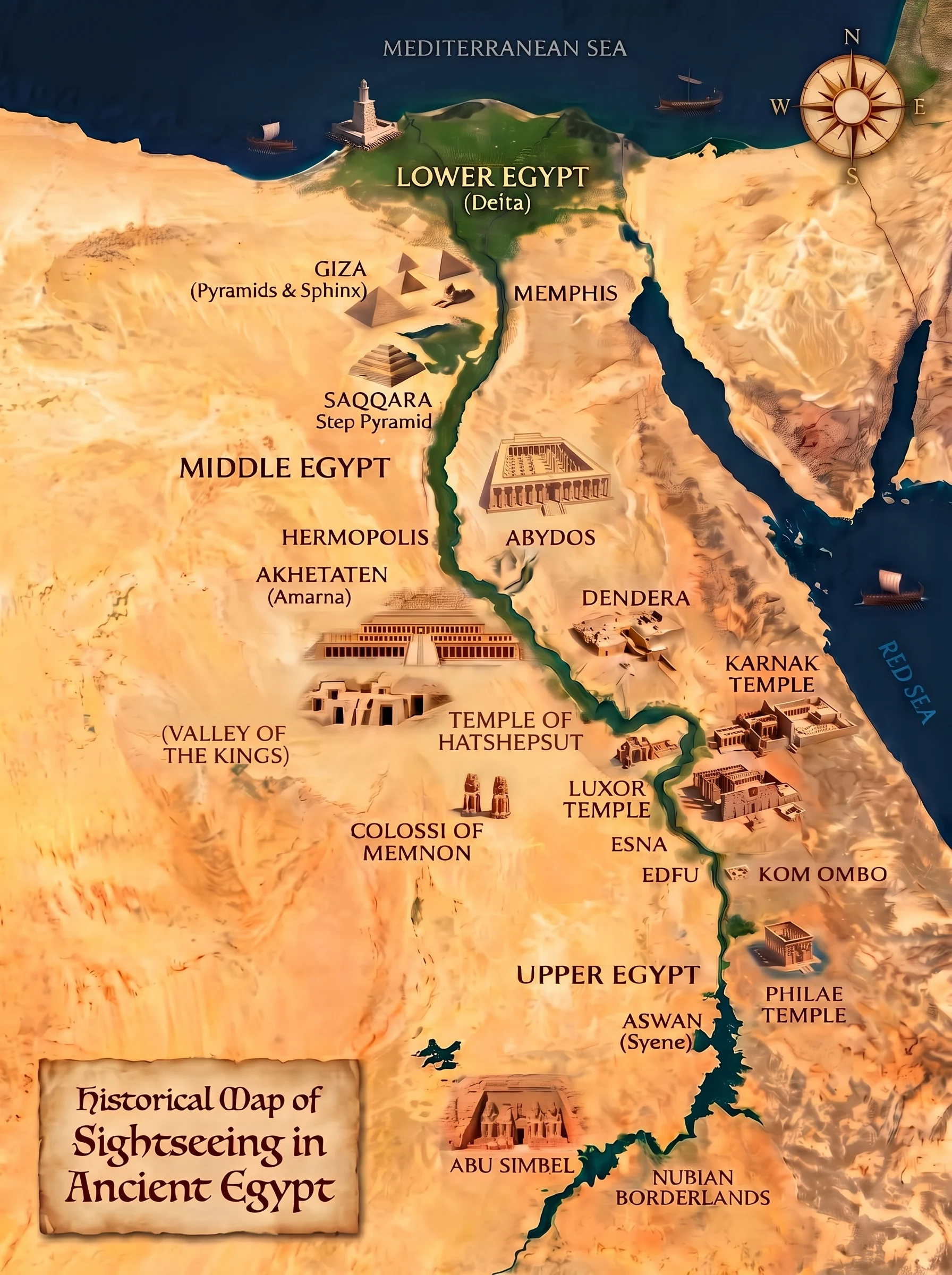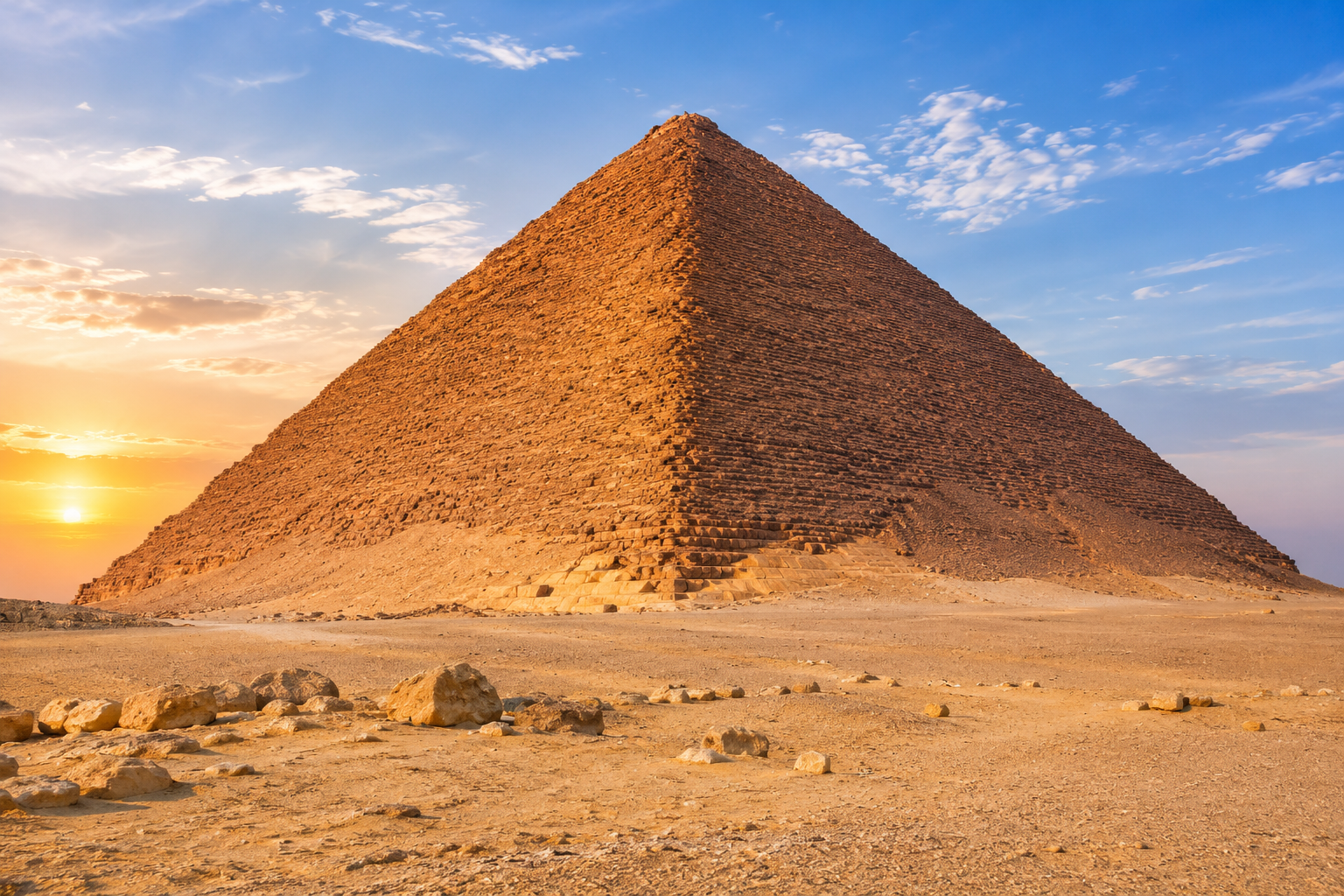
Most people picture the Great Pyramid of Giza when they think of Egypt’s pyramids. But about 40 kilometers south of Cairo, in the quiet desert necropolis of Dahshur, stands a pyramid that many archaeologists find even more fascinating: the Red Pyramid. It is older than Giza’s famous trio, almost as large as the Great Pyramid, and far less crowded. Here is why it deserves a place on your list.
What Is the Red Pyramid?
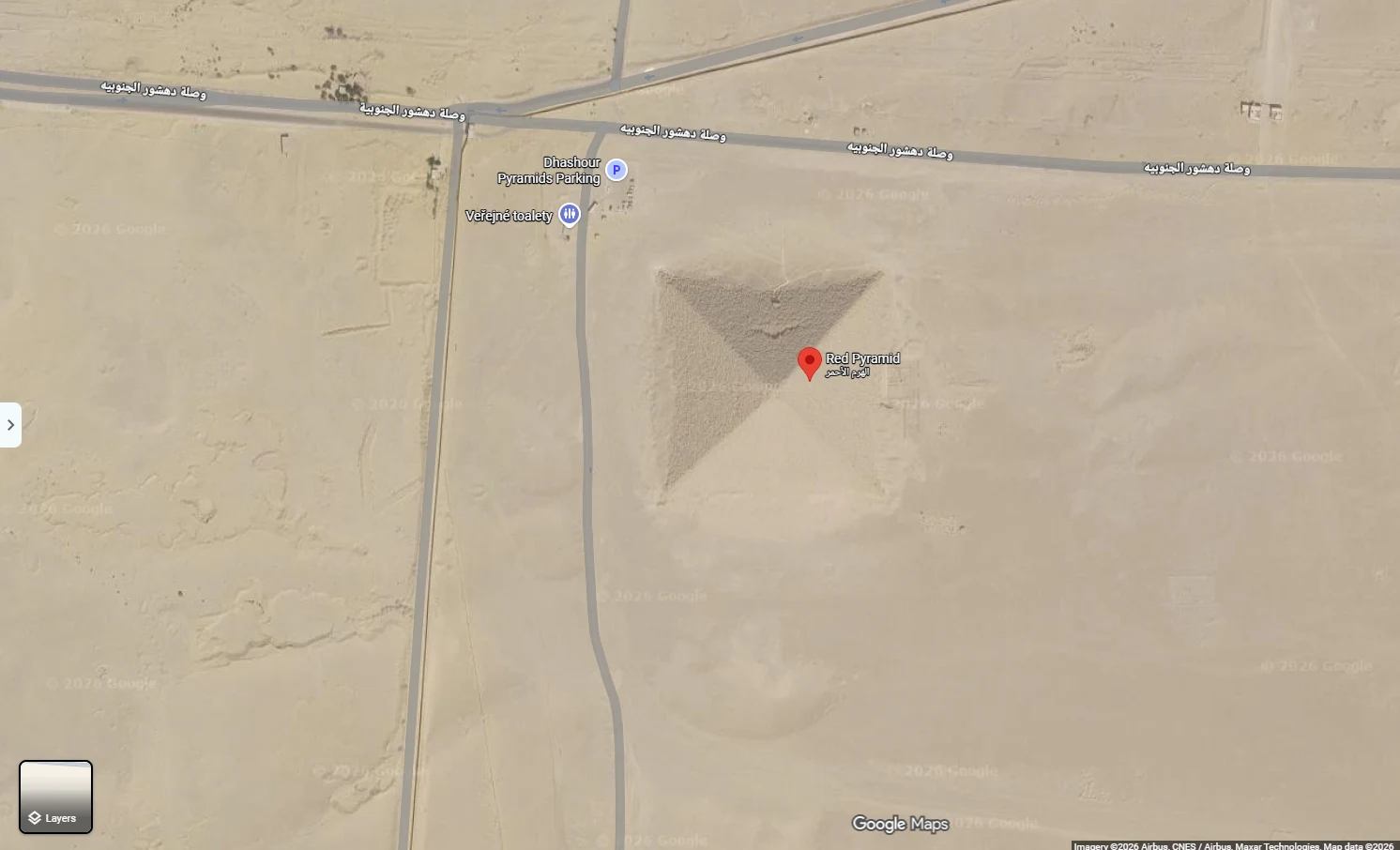
The Red Pyramid, also called the North Pyramid, was built for the pharaoh Sneferu, who ruled during the Fourth Dynasty, around 2600 BCE. It is the third largest pyramid in Egypt, after the pyramids of Khufu and Khafre at Giza. It rises roughly 104 meters (about 340 feet) and has a base of about 220 meters on each side.
What makes it historically special is that it is widely regarded as the first successful true smooth-sided pyramid. Every great pyramid built afterward, including Giza’s, inherited lessons learned here.
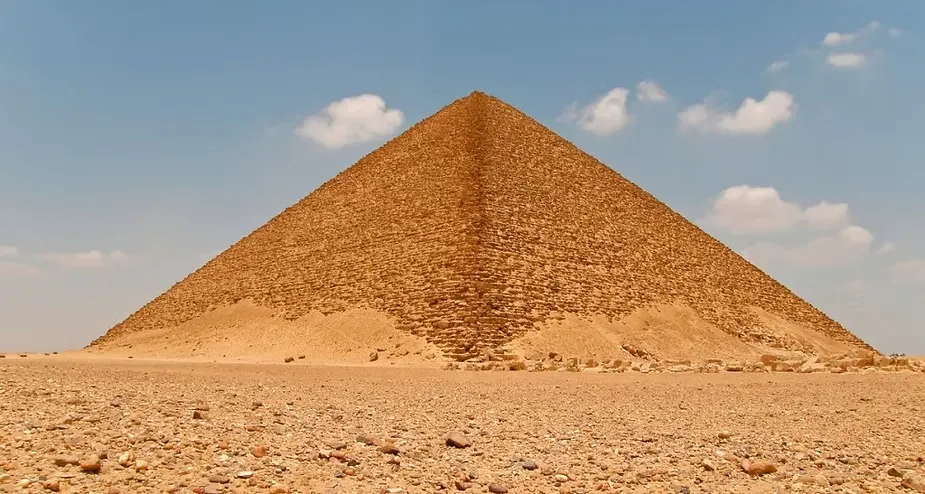
Why “Red”?
The name comes from the color of its stone. The core of the pyramid is built from reddish limestone, and as the sun rises or sets, the weathered blocks glow a warm rusty pink. Originally, the pyramid was covered in a smooth casing of fine white limestone, but over the centuries, most of it was removed and reused in buildings across Cairo. What remains is the reddish heart of the monument.
Ministry of Tourism and Antiquities
A Story of Trial and Error
Sneferu was one of ancient Egypt’s greatest builders, and he completed several pyramids. Together they tell the story of engineers learning as they went:
- Meidum: an early attempt that was ultimately converted from a stepped form to a smooth-sided one, and later suffered a major collapse.
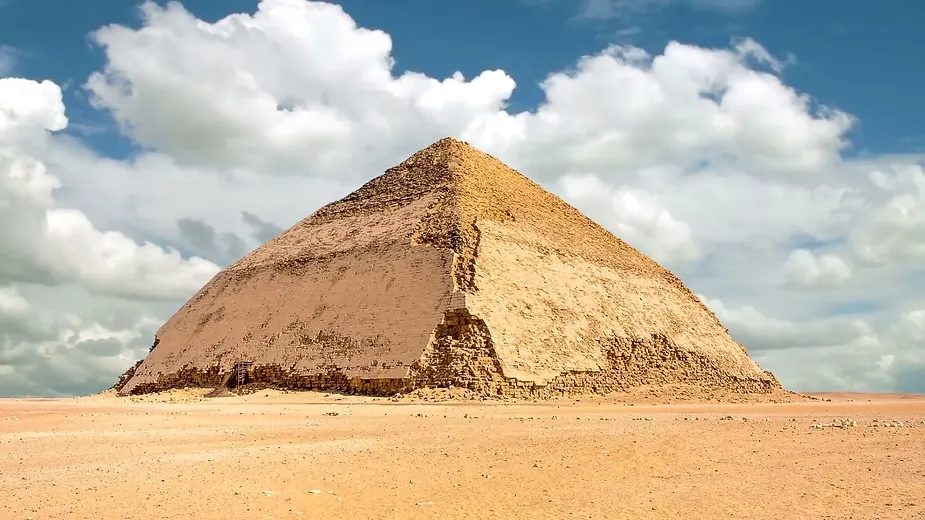
- The Bent Pyramid: also at Dahshur, it begins at a steep angle of about 54 degrees and then abruptly shifts to a shallower slope higher up, giving it the odd, bent profile. Builders likely changed the angle because of structural instability.
- The Red Pyramid: built with a gentler angle of roughly 43 degrees from the base to the peak, it was stable, and it worked.
That gentler slope is the secret to its success. Standing in front of it, you are looking at the moment ancient engineers got the formula right.
Inside the Pyramid
Unlike many pyramids that are closed to visitors, the Red Pyramid can be entered. The entrance is high up on the north face, reached by climbing a long staircase of about 125 steps. From there, you descend through a narrow, sloping passage of around 60 meters into the heart of the monument.
The passage opens into two antechambers with beautiful corbelled ceilings, which rise to about 12 meters in a stepped, inverted-staircase style. A short climb then leads to the main burial chamber, which has the same dramatic vaulted ceiling. Expect a warm, dusty, and somewhat ammonia-scented atmosphere, but also an unforgettable sense of standing inside real Old Kingdom architecture, with far fewer people around than at Giza.
Visiting Tips
- Go early. The desert gets hot quickly, and the staircase and passage are physically demanding in the midday sun.
- Wear comfortable shoes and bring water. The descending passage is low, so you will need to stoop for much of it.
- Combine it with the Bent Pyramid. The two sit close together in the same area, so you can see them both in a single trip.
- Hire a driver or join a tour. Dahshur is not served by regular public transport, so most visitors arrive from Cairo by car. Check current opening hours and ticket prices before you go, as they change from time to time.
- Bring a small flashlight and a light layer. Passage lighting can be limited, and the air inside can feel stuffy.
Why It Matters
The Red Pyramid is a reminder that the wonders of ancient Egypt were not built overnight, and certainly not without mistakes. It marks the point where an ambitious pharaoh and his builders turned experiments into a lasting formula. Seen at sunset, its stones glowing and the desert silent, it feels less like a tourist attraction and more like stepping back into the workshop of the pyramid age.
If you want to experience Egypt’s pyramids without the crowds, the Red Pyramid is the one to choose.
Learn More>>> Siwa Oasis: 3-Day Itinerary, Camping & Travel Guide
Don’t Miss the Bent Pyramid
Just a few kilometers south of the Red Pyramid stands its older, stranger sibling: the Bent Pyramid. Also built for Sneferu, it is one of the most unusual monuments in all of Egypt, and it makes the perfect companion visit.
A Pyramid That Changed Its Mind
The Bent Pyramid rises about 105 meters, with a base of roughly 188 meters per side. Its lower half climbs steeply at about 54 degrees, but around the halfway point the angle suddenly softens to about 43 degrees, the same gentle slope the Red Pyramid would later use all the way up. The result is a distinctive, almost bulging silhouette that no other pyramid shares.
The most widely accepted explanation is that the builders noticed signs of structural trouble as the monument grew, and reduced the angle to lighten the load and finish the job safely. Whether or not the earlier collapse at Meidum played a part, the Bent Pyramid is a rare frozen record of engineers adjusting their plans in real time.
Why It’s Special
- Remarkably preserved casing. Much of its original smooth white Tura limestone covering still clings to the pyramid, giving you the best idea anywhere of how these monuments originally looked.
- Two entrances. Unlike most pyramids, it has one entrance on the north face and another on the west, leading to separate chamber systems with impressive corbelled vaults.
- A story you can read in the stone. Walking around it, you can see the change of angle for yourself, which makes the history of pyramid-building feel tangible.
Access to the interior has varied over the years, so check current opening arrangements before you go. Even if you only admire it from outside, it is well worth the stop.
The Best of Both
Seen together, the two pyramids tell a complete story: the Bent Pyramid shows the experiment and the course correction, and the Red Pyramid shows the finished solution. If you only have time for one day trip south of Cairo, Dahshur lets you walk through that evolution in a single morning.