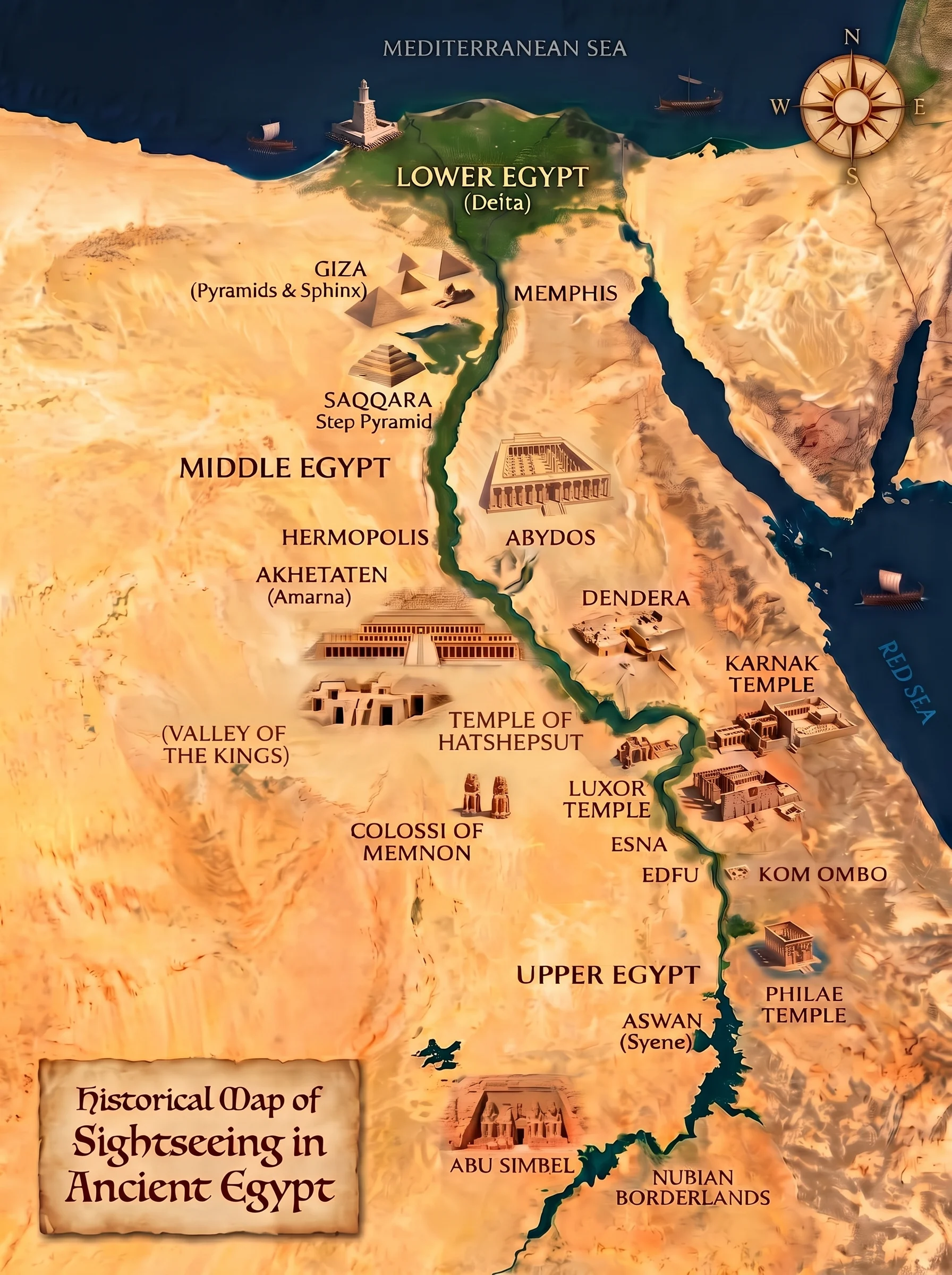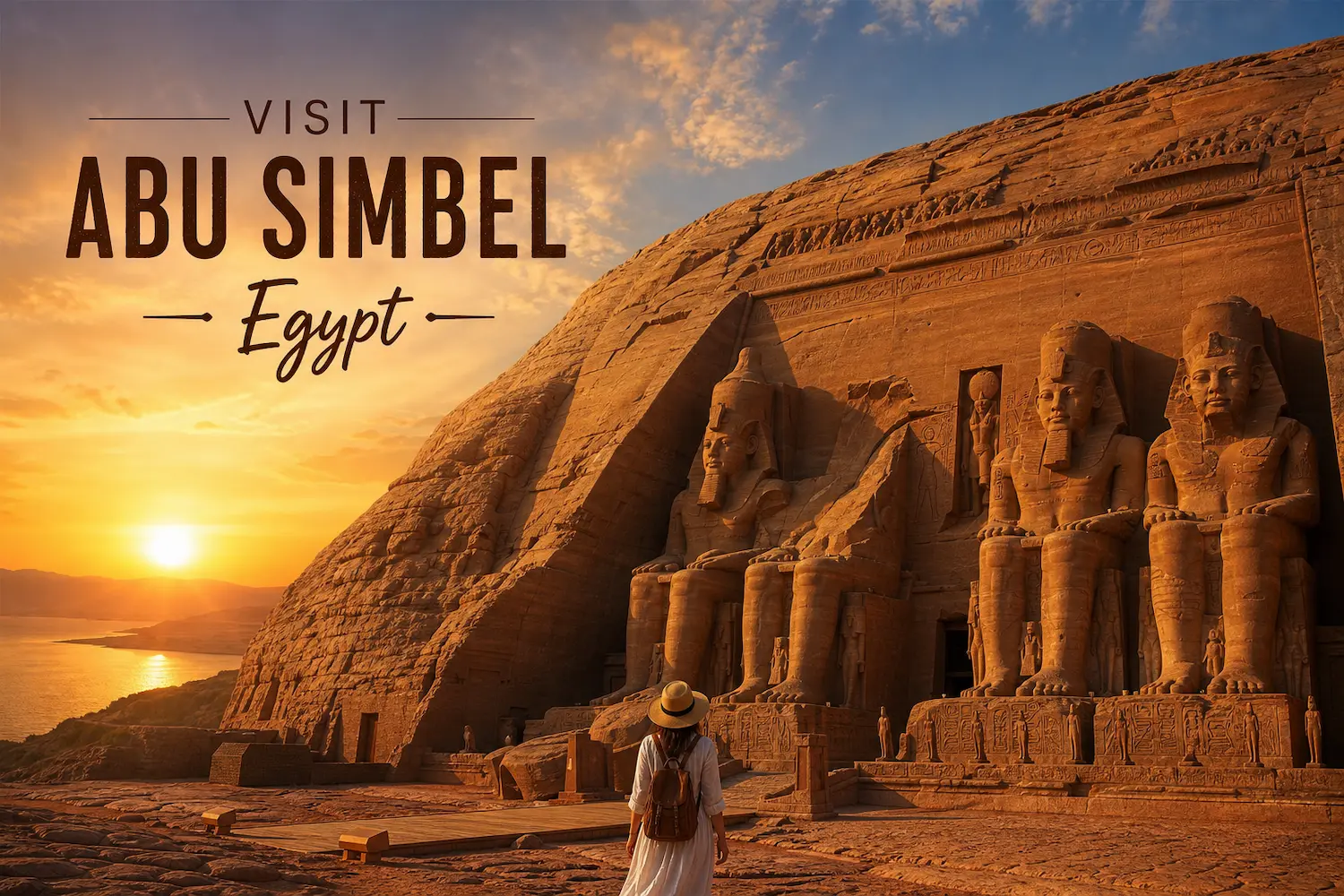
Quick Answer: The most common way to visit Abu Simbel Temple is by booking a guided day trip or a 45-minute flight from Aswan. Located 280 kilometers south, the temples require a three-to-four-hour drive each way. Travelers typically depart Aswan early in the morning by private car or minibus to avoid the midday heat, spending two to three hours exploring the colossal Great Temple of Ramses II.
Picture this: you round a bend in the Nubian desert, Lake Nasser stretches silver in the early light, and
suddenly two colossal rock-cut facades rise from the sandstone cliff ahead of you.
Four statues of Ramesses II, each standing about 20 meters tall, stare across the water with the same calm authority they’ve held for three thousand years.
That’s the moment most visitors describe as the one that stopped them cold. Abu Simbel temple in Egypt does that. It earns the journey.
Is a Day Trip to Abu Simbel Temple Worth to Visit?
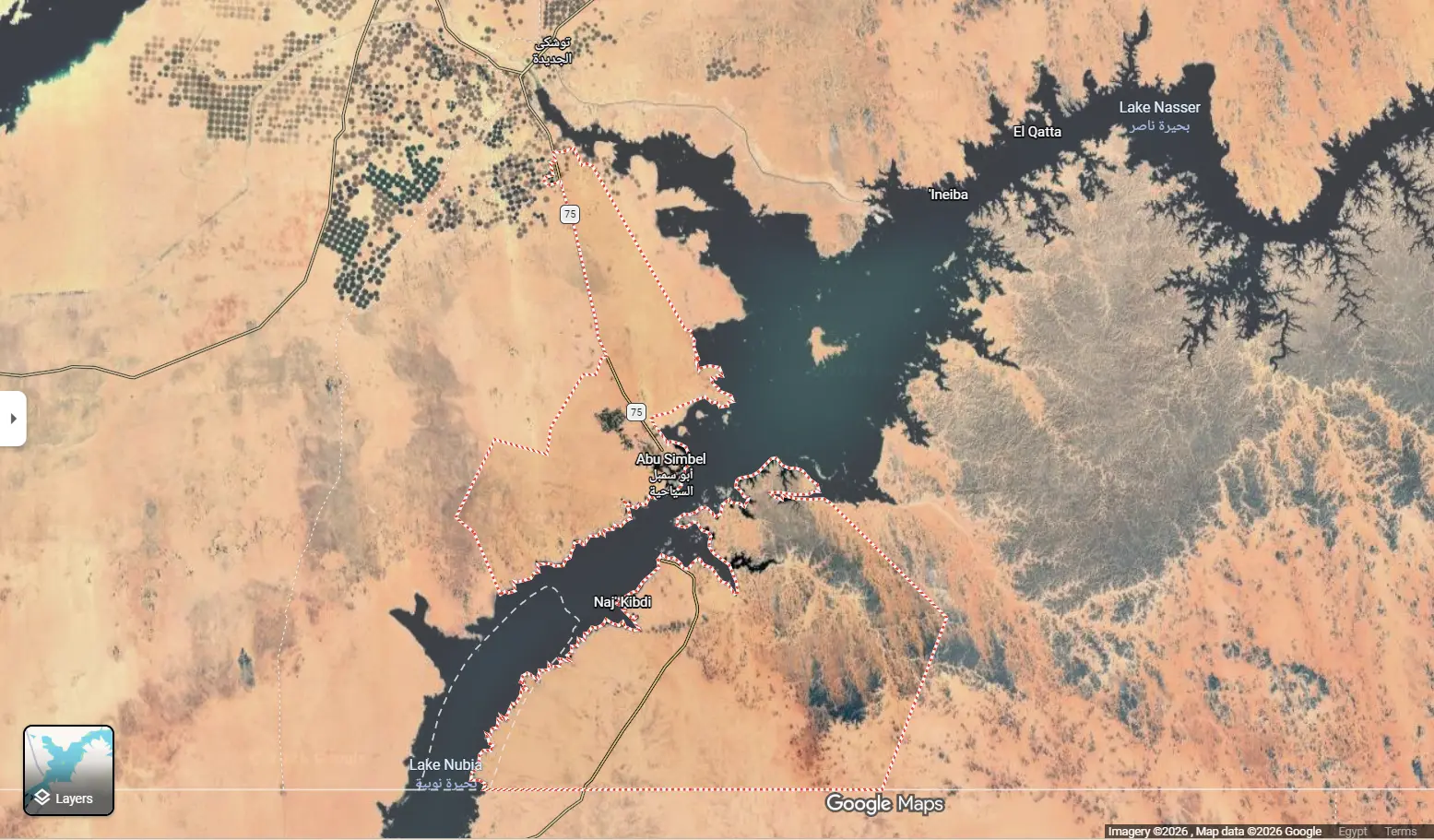
Yes, a day trip to Abu Simbel Temple is worth it if you want to see one of the most powerful temple sites in Egypt. The temples sit near Lake Nasser, far south of Aswan, close to the Sudanese border. The journey feels long, but the reward feels special.
You will see four giant seated statues of Ramses II carved into the rock. You will walk into the temple and see ancient scenes, columns, carvings, and stories from more than 3,000 years ago.
Nothing ends an Egyptian journey quite like standing in front of those four colossal statues as the sun
rises over Lake Nasser and the desert stretches out in every direction. That image stays with you.
Also, you visit the smaller temple of Queen Nefertari, which many travelers find just as beautiful. Abu Simbel Temple also has one amazing modern story.
UNESCO explains that the temples were cut into more than 1,000 blocks, moved, and rebuilt higher above the water to save them from Lake Nasser after the Aswan High Dam project. The new site sits 64 meters above the old site and 180 meters inland. UNESCO World Heritage Centre
What makes these temples extraordinary is the layered story behind them. They were carved directly into
a Nubian mountainside to project Egyptian power across the southern frontier.
They were saved from permanent submersion under Lake Nasser by one of the largest international heritage rescue operations ever mounted.
And they still align with the rising sun on two specific mornings every year, exactly as their builders intended. Getting here takes planning, whether you fly from Aswan or make the four-hour desert
drive, but nothing else on an Egypt itinerary delivers quite the same impact.
This guide covers everything you need to visit Abu Simbel Temple in Egypt: the history, the solar
phenomenon, what to expect inside both temples, your real transport options from Aswan, and how to
decide between a day trip and an overnight stay
Why Ramesses II Built These Temples (and What He Was Trying
to Say)
The Political Statement Carved into Sandstone
Construction began around 1264 BCE, during the reign of Ramesses II of Egypt’s 19th Dynasty. The Great
Temple of Abu Simbel Temple was not a modest place of worship. It was a deliberate act of dominance carved
into Nubian rock to remind the southern frontier exactly who held power.
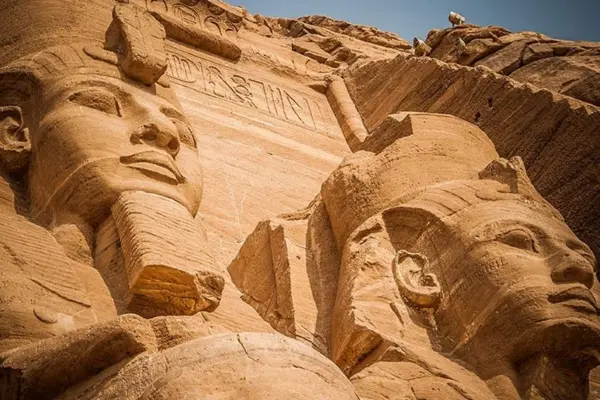
Four colossal statues of Ramesses II, each roughly 20 meters tall, flank the entrance facade, visible across the Nile long before any traveler reached the temple doors.
The interior was dedicated to Amun-Ra, Ra-Horakhty, and Ptah, along with Ramesses II himself, who appears in the sanctuary in deified form alongside the gods.
The smaller Temple of Hathor, built for Queen Nefertari, carries its own remarkable statement. Its six standing colossi alternate between figures of Ramesses and his wife, carved at equal scale.
In ancient Egypt, depicting a queen at the same size as a pharaoh was virtually unheard of; it was a profound act of devotion. Battle reliefs inside the Great Temple depict the famous Battle of Kadesh in vivid detail, turning the temple walls into the ancient world’s version of a victory announcement.
The Two Dates and What Happens
On February 22 and October 22 each year, the rising sun penetrates 60 meters through the Great Temple’s main corridor and illuminates the inner sanctuary. The light show lasts roughly 22 minutes, with the peak illumination falling approximately between 6:54 and 7:16 AM based on recent observations.
February 22 is traditionally associated with Ramesses II’s coronation; October 22 with his birthday, though these correspondences reflect long-standing commemorative tradition rather than confirmed archaeological record.
Large crowds of visitors and photographers gather for both dates annually, and the experience is unlike anything else at an archaeological site anywhere in the world.
Worth noting: due to the precession of Earth’s axis over three millennia, the original alignment dates were February 21 and October 21. The one-day shift reflects just how long these temples have been standing.
Which Statues Light Up, and Which Stays Dark
Three of the four seated statues in the sanctuary are illuminated during the event: Ramesses II, Ra-
Horakhty, and Amun-Re. The statue of Ptah, god of the underworld, remains in permanent shadow. This
was a deliberate design choice, not a coincidence.
The ancient Egyptians embedded cosmological logic directly into the temple’s orientation, keeping the god of darkness unlit even as the sun reached deep into the sanctuary.
Even on a regular visit outside the solar festival dates, understanding this architectural detail completely changes how you read the interior’s layout and intention.
What You’ll Actually See When You Arrive On-Site
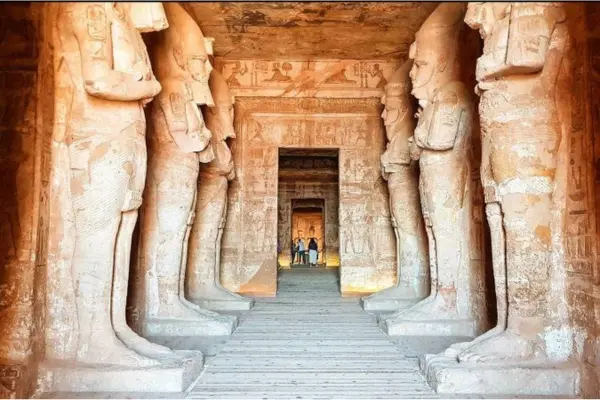
Inside the Great Temple of Ramesses II
Walking through the rock-cut facade and into the hypostyle hall is a genuinely striking experience. A row
of Osirid pillars carved with the face of Ramesses II lines the main corridor.
The walls are covered in battle reliefs, with the scenes from the Battle of Kadesh among the most detailed and dramatic in any Egyptian monument.
The interior is cool, dimly lit, and surprisingly intimate given the enormous scale of what you just walked past outside. Allow 45 to 60 minutes inside the Great Temple, depending on how deeply you want to take in the hall, the side chambers, and the inner sanctuary.
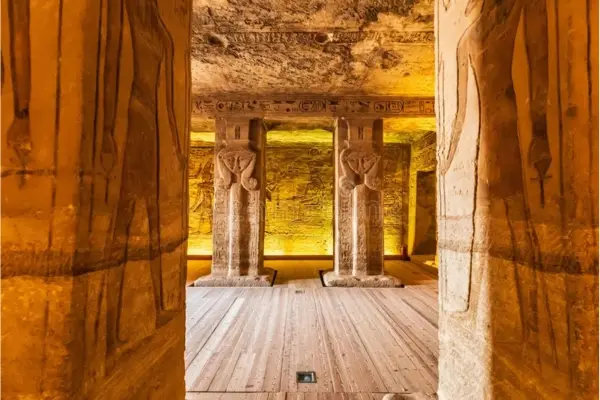
The Temple of Hathor and Nefertari
Just north of the main temple, the Temple of Hathor is smaller but equally detailed. Its six standing
colossi, alternating between Ramesses and Nefertari at equal height, set the tone immediately.
Inside, Hathor-headed columns frame reliefs showing Nefertari making offerings to the gods, scenes that feel more personal and human than the grand military proclamations of the Great Temple next door.
Most visitors spend 20 to 30 minutes here. The temple is easy to underestimate from the outside, but the story behind it, a pharaoh honoring his queen in stone on this scale, adds real depth to the entire site visit.
Can You Do Abu Simbel Temple as a Day Trip from Aswan?
Yes, Abu Simbel Temple works very well as a day trip from Aswan. In fact, this is the most common way tourists visit it.
Aswan is the best base because it is the closest major tourist city to Abu Simbel. From Luxor, Hurghada, Cairo, or Marsa Alam, the journey becomes much longer and usually needs extra planning.
If your Nile cruise ends or starts in Aswan, you can also add Abu Simbel Temple before or after the cruise.
How Long Does a Day Trip to Abu Simbel Temple Take from Aswan?
A day trip to Abu Simbel Temple usually takes a full day, around 8 to 10 hours. The road distance from Aswan to Abu Simbel is about 283.5 km, with an estimated driving time of around 4 hours.
Most travelers leave Aswan very early in the morning, often around 4:00 AM to 5:00 AM. The drive takes around 3.5 to 4.5 hours each way, depending on traffic, stops, vehicle type, and road conditions.
A normal day looks like this:
- 4:00 AM – 5:00 AM: Pickup from hotel or Nile cruise in Aswan
- 8:00 AM – 9:00 AM: Arrive at Abu Simbel Temple
- Visit the Great Temple of Ramses II
- Visit the Temple of Queen Nefertari
- Lunch
- Drive back to Aswan
- 3:00 PM – 4:00 PM: Arrive back in Aswan
How Much Does It Cost to Visit Abu Simbel Temple?
The cost depends on three things:
- entrance ticket
- transport from Aswan
- guide or tour package
At the time of writing, the official Egyptian e-ticket website lists Abu Simbel Temple standard tickets for foreign visitors at EGP 822 for adults and EGP 445.5 for students.
On the Sun Alignment dates, February 22 and October 22, the ticket price rises to EGP 1272 for adults and EGP 670.5 for students. and the payment is only by cards. Prices can change, so travelers should always check the official ticket page before visiting. egymonuments.com
A tour package may include:
- hotel pickup and drop-off
- private car or shared minibus
- licensed driver
- tour guide
- entrance tickets, sometimes
- Lunch
- bottled water, sometimes
Learn More>> Abu Simbel Private Day Trip from Aswan
Always ask before booking:
“Is the Abu Simbel entrance ticket included?”
This avoids surprise costs on the day.
What Should I Pack for an Abu Simbel Day Trip?
- passport copy or ID
- sunglasses
- hat or cap
- sunscreen
- comfortable walking shoes
- light clothes
- small jacket in winter mornings
- water
- snacks
- camera or phone
- power bank
- cash or card for extras
Is Abu Simbel Temple Safe to Visit?
Yes, Abu Simbel is generally safe for tourists when you visit with a licensed driver, trusted tour company, or organized transfer.
The road from Aswan to Abu Simbel Temple is a known tourist route. Travelers use it daily. The most important safety points are simple:
- book with a trusted company
- avoid unknown street offers
- check what the price includes
- wear your seatbelt
- follow site rules
For solo travelers and families, a private tour gives extra comfort because you know who picks you up and when you return.
How Hot Is Abu Simbel Temple?
Abu Simbel can feel very hot, especially from late spring to early autumn. The sun feels strong because the site sits in an open desert area.
Summer can feel difficult for some travelers. Winter feels much more comfortable, especially in the morning.


Best comfort months:
- October
- November
- December
- January
- February
- March
- April
Hardest heat months:
- June
- July
- August
- early September
If you visit in summer, leave very early, wear a hat, use sunscreen, and drink water before you feel thirsty.
Learn More>> Egypt Weather Forecast Travel Guideline: Best Time to Visit Egypt
Getting from Aswan to Abu Simbel: Your Real Options
Flying: The Fastest Way There
EgyptAir operates direct flights from Aswan Airport (ASW) to Abu Simbel Airport (ABS), with the flight
taking around 40 to 45 minutes. Round-trip fares typically run in the range of US$90, 110 per person,
though prices vary by season and availability.
From Abu Simbel airport, the temples are a 5-minute taxi ride away. Flying eliminates 3.5 to 4 hours of desert driving each way and is the right call for travelers short on time or visiting during peak heat months. Book well ahead: the route isn’t daily, and seats fill quickly during the November-to-February tourist season.
Private Car or Organized Day Tour
The road from Aswan runs about 280 km along Lake Nasser through open desert, taking roughly 3.5 to 4
hours each way. Most organized tours depart Aswan hotels around 4:00 AM, reaching the site by opening
time and allowing 2 to 3 hours on-site before the return drive.
This is the most popular option for independent travelers and small groups because it’s comfortable, flexible, and puts you in control of your time at the temples. A private car or guided tour also lets you stop along the route, which the flight obviously doesn’t.
For travelers interested in longer desert excursions beyond Abu Simbel, consider a Private Siwa Oasis Tour 3 Days | Salt Lakes
Early morning is best because the weather feels cooler and the light is better for photos.
Yes. You can hire a private driver or arrange transport, but a tour makes the day easier.
Yes, but the long drive can feel hard for young children. A private car works better for families.
Abu Simbel Temple Egypt Is Worth Every Kilometer
These Nubian temples earn every kilometer of the journey from Aswan. The decision is straightforward:
fly if your time in Egypt is tight, drive if you want flexibility and a Lake Nasser panorama, or commit to an
overnight stay if you’re targeting the solar alignment in February or October.
Travelers already on a Nile cruise between Luxor and Aswan are perfectly positioned to extend their itinerary south, and it’s the kind of extension that turns a great trip into an unforgettable one.
If you’re planning your Egypt itinerary and want to pair an Abu Simbel excursion with a Nile cruise or a
Luxor, Aswan package, Sunny Egypt Team can build that into your trip from the start. Our multilingual-speaking guides and private transport options mean you won’t be piecing together multiple providers to
make Abu Simbel Temple, work as part of a longer journey.
One operator, one itinerary, no gaps. For related itinerary ideas, see our guide Can You Do a Day Trip to Luxor from Aswan?